
Some links in this article are affiliate links. If you book through them we may earn a small commission, at no extra cost to you. We only recommend experiences we'd send a friend to.
Travelers planning a Spain trip with limited time eventually arrive at the same question: Barcelona or San Sebastián? They're the two cities most associated with great food, they sit on opposite sides of the country, and you usually can't see both unless you're committing 10+ days.
I'll spare you the "they're both wonderful in their own way" preamble. They're both wonderful. But they are wonderful in different ways, and most travelers will be happier in one than the other.
This guide is what I tell friends asking the question. It covers the genuine differences, what each city does better, what each does worse, who should pick which, and whether you can actually fit both into one trip.
The short answer:San Sebastián has the better food, top to bottom. Barcelona is the better trip for most travelers, more variety, easier to reach, more to do beyond eating. If food is your only reason for visiting Spain, choose San Sebastián. For any other priority, choose Barcelona.
The food itself
Here's where it isn't close. San Sebastián has better food.
This isn't a niche opinion. It's the consensus among food writers, chefs, and travelers who've spent serious time in both. San Sebastián has the highest concentration of Michelin stars per capita of any city in the world. The pintxos bars in the old town serve food at a quality level that would charge twice as much in any Western capital. And the regional Basque cuisine, built on a coastline of exceptional seafood, the world's best beef cattle, and a culinary culture that takes ingredient sourcing seriously, has fewer mediocre dishes than Catalan cuisine. The floor is just higher.
Barcelona has incredible food too. But the gap between the best meals and the average meals is wider in Barcelona, which means more risk of mediocre experiences if you don't know where to go. San Sebastián is more forgiving, even random pintxos bars tend to be good, because the locals would shut down anything that wasn't.
Specifically, on individual dish categories:
Seafood: San Sebastián wins, decisively. Direct Atlantic access, a strong fishing tradition, and a culture that respects the ingredient. Barcelona's seafood is fine but mostly farmed Mediterranean varieties.
Beef: San Sebastián wins. Basque beef, particularly aged chuleta from old dairy cattle, is genuinely world-class. Most Barcelona steakhouses import their meat.
Vegetables: Close, but Barcelona edges it. Catalonia's farmlands feed Barcelona with seasonal produce that shows up at La Boqueria and decent restaurants. San Sebastián's vegetable game is fine but secondary to seafood and meat.
Cured meats: Barcelona wins. Jamón ibérico, fuet, butifarra, Catalonia's charcuterie tradition is deeper. Basque charcuterie exists but isn't the headline event.
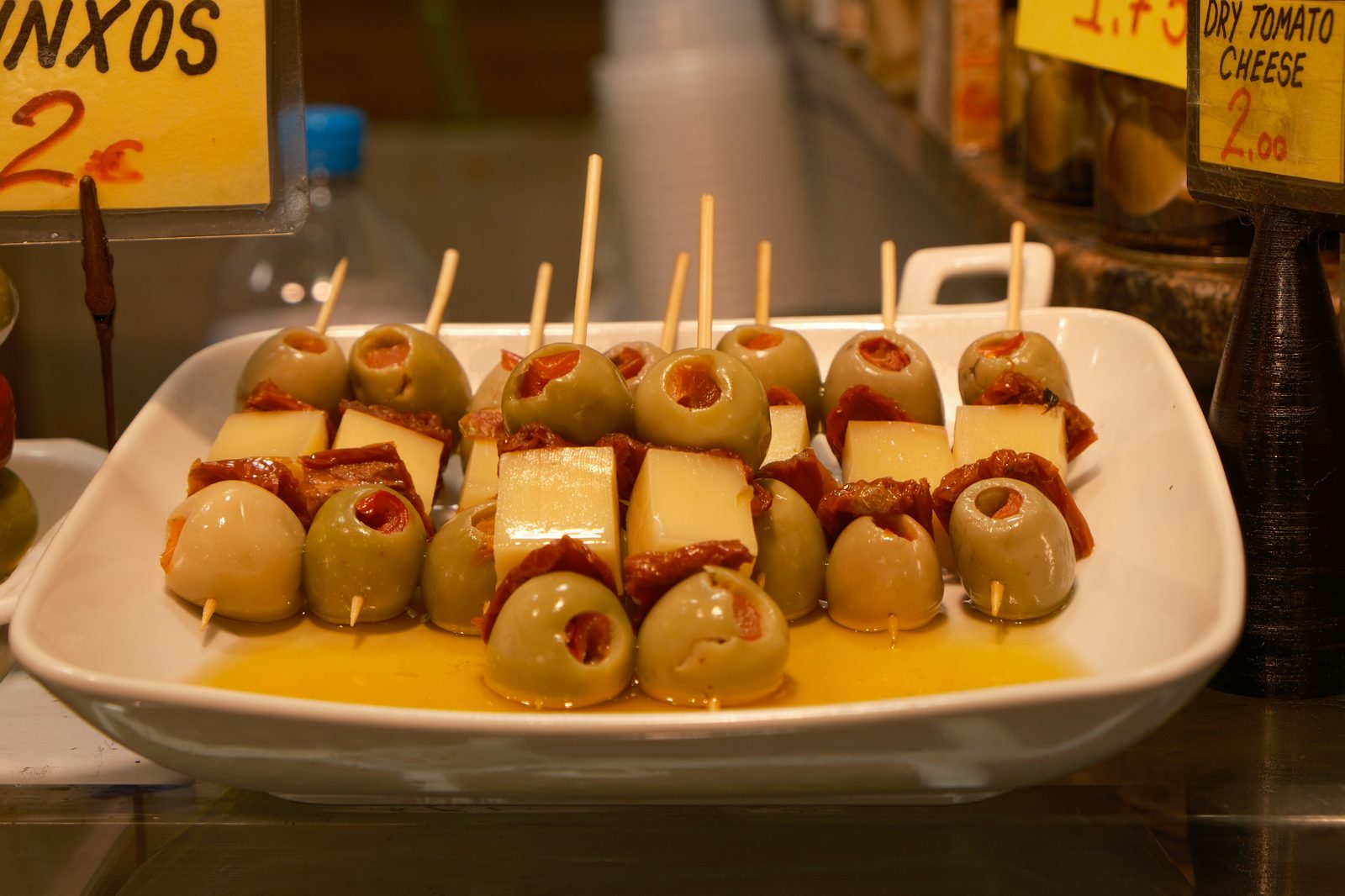
Bar snack ecosystem: San Sebastián. The pintxos format produces consistently better small bites than Barcelona's tapas, fresher, more carefully composed, served right in front of you on a counter. Barcelona's tapas are more varied but more inconsistent.
Sweets: San Sebastián. Basque cheesecake (now a worldwide phenomenon, invented at La Viña in San Sebastián's old town). Pintxos bars often have a sweet pintxo or two.
The experience of eating
Here's where San Sebastián's win is harder to overstate, and where Barcelona's gap is widest.
San Sebastián has a small concentrated old town, Parte Vieja, about three blocks by three blocks, packed with maybe 80 pintxos bars within walking distance of each other. You go on a txikiteo: a pintxos crawl where you have one or two bites at each bar, then move to the next. Each bar has different specialties. The whole thing is built for grazing.
By 8pm the old town fills up. Locals stand at the bars, eating, drinking txakoli (the local white wine), having loud conversations, ordering more pintxos. It feels like the city's collective dining room. Visitors blend in immediately. It's a near-perfect food culture experience that you simply cannot find anywhere else in the world.
Barcelona doesn't have an equivalent. The food scene is dispersed across El Born, the Gothic Quarter, Gracia, Sant Antoni, Poble Sec, all neighborhoods worth visiting, all great, but you'll spend more time walking and less time eating. The bar culture is good but quieter, slightly more reserved. The vermouth tradition is wonderful but contained to Sundays and small windows of the day.
If Barcelona wins, we've written up the food tours worth booking neighborhood by neighborhood: the Gothic Quarter, El Born, Gràcia, Sant Antoni and the Eixample, the modernista grid where far fewer visitors eat.
If your ideal trip looks like "spend three hours wandering between excellent bars, never sit down, eat constantly," San Sebastián is the only answer. Barcelona's food culture is more like "find a good restaurant or two, sit, order, enjoy", different rhythm, less immersive.
What Barcelona does better
Now the case for Barcelona, which is real.
Variety beyond food. Barcelona has Gaudí. Beaches. Montjuïc. A football stadium that drew 90-000 people last weekend. A nightlife scene. A modern art world. World-class shopping. Day trips to Montserrat or the Costa Brava. You can spend a week there and not run out of things to do.
San Sebastián is small. The food is the headline, the beach (La Concha) is beautiful but you've seen it after a day, and beyond that there's not much. After three days, most visitors are scratching for activities. It's a food destination, not a city destination.
Accessibility. Barcelona has a major international airport with direct flights from most of Europe and many U.S. cities. You can get there from London in two hours, from New York in seven. San Sebastián has a small regional airport with limited routes; most visitors connect through Madrid or Bilbao, adding 3-5 hours to the trip.
Cost. Pintxos are not cheap. A serious pintxos crawl in San Sebastián can easily run €60-80 per person per evening before drinks. Barcelona tapas, especially in neighborhoods locals actually use, can be done for €30-40 per person. San Sebastián also has fewer mid-range restaurants, it's pintxos bars or Michelin tasting menus, with less in between.
Year-round usability. Barcelona is Mediterranean. The food scene functions in any season. San Sebastián is Atlantic, gray skies, cold rain from October through May, with most of the appeal happening on outdoor terraces that are unusable in winter. Visit San Sebastián in February and you'll get half the experience.
Solo travel friendliness. Barcelona is full of solo travelers, hostels, English speakers, and easy social environments. San Sebastián's pintxos crawl is a deeply social activity, solo travelers can do it but the vibe is more group-oriented. It's worth knowing.
Catalan cuisine itself. Setting aside the pintxos vs tapas debate: Catalan food has its own incredible deep tradition. Esqueixada, escalivada, fideuà, calçots in season, the long Sunday lunch culture, vermouth hour. Barcelona is genuinely a great food city, it just happens to share a country with one that's a bit greater.
The "can I do both" question
It's a fair question and the honest answer is: only if you have at least 8 days in Spain and don't mind one travel day eating into your trip.
The geography matters. Barcelona is on the Mediterranean coast in the northeast. San Sebastián is on the Atlantic coast in the north, near the French border. They're 5.5 hours apart by car, 5-6 hours by train, or a 1-hour flight (plus airport overhead, so really 4 hours door to door).
If you have 10+ days, the natural itinerary is:
- Fly into Barcelona, spend 4 days
- Train or fly to San Sebastián, spend 3 days
- Optionally tack on Bilbao or Madrid before flying home
If you have less than 8 days, pick one. The travel time between them is real and the experience of each city is diminished if you only have a day or two.
One more option worth knowing: many people combine San Sebastián with Bilbao (1 hour away, has the Guggenheim, easier flights) rather than Barcelona. This is the local approach, most Spaniards visiting San Sebastián for food fly into Bilbao first.
Who should pick which
Pick San Sebastián if…
- Food is your primary reason for visiting Spain
- You want a serious eating-focused trip with no compromise
- You've been to Spain before and want to go deeper
- You're traveling with a partner or small group of food enthusiasts
- You're visiting in late spring through early fall (May,October)
- You don't mind a smaller city with less to do beyond eating
- You have at least 3 full days to commit to it
Pick Barcelona if…
- You want food to be a major part of your trip but not the only part
- You're traveling with kids, non-foodies, or anyone who'd want variety
- It's your first trip to Spain
- You're visiting outside summer (Barcelona is more all-season)
- You want city energy, nightlife, architecture, beaches
- You have a tighter budget
- You're traveling solo and want a social environment
- You only have 3-5 days in Spain
How to do food well in either city
The same advice applies to both: book a guided food experience on day one or two. It orients you to the local food culture, teaches you what to order, and gives you a list of places to return to for the rest of your trip. The €80-100 cost saves you from dozens of wasted meals at tourist traps.
In Barcelona, we've ranked the nine best food tours separately. The top pick covers pan con tomate, jamón, croquetas, patatas bravas, and a sit-down dish in three hours.
In San Sebastián, the equivalent is a pintxos crawl with a local guide. The format works particularly well there because the old town's compact size means a guide can hit 4-5 standout bars in a single evening. Viator has the full San Sebastián food tour catalog here, look for tours that emphasize the Parte Vieja (old town) and include txakoli pairings. We'll publish a dedicated San Sebastián city page soon with curated picks.
Get the free Spain food guide
Six pages to keep on your phone: how tapas and pintxos work, the phrases that get you served, and what to eat in Madrid, Barcelona and San Sebastián.
The real answer
If I'm honest: most travelers asking this question should pick Barcelona. They're usually first-time Spain visitors, they want variety, they have limited time, and they want a trip that works for more than just eating. Barcelona delivers all of that with food that, while not quite San Sebastián's level, is still excellent by any global standard.
San Sebastián is for the second trip. After you've done Barcelona and Madrid (if you're choosing between those two, see Madrid vs Barcelona for food) and decided you love Spanish food enough to plan a trip specifically around it, you fly into Bilbao, drive to San Sebastián, and spend three days eating your way through Parte Vieja. That's the trip San Sebastián is built for.
Both are great. Don't agonize over the choice. The wrong answer is staying home.
For more on what to eat in Barcelona if you go that way, see our guide to the 15 dishes worth prioritizing. For the foundational question of how Spanish food culture actually works in either city, see how tapas and pintxos differ across Spain.