
Some links in this article are affiliate links. If you book through them we may earn a small commission, at no extra cost to you. We only recommend experiences we'd send a friend to.
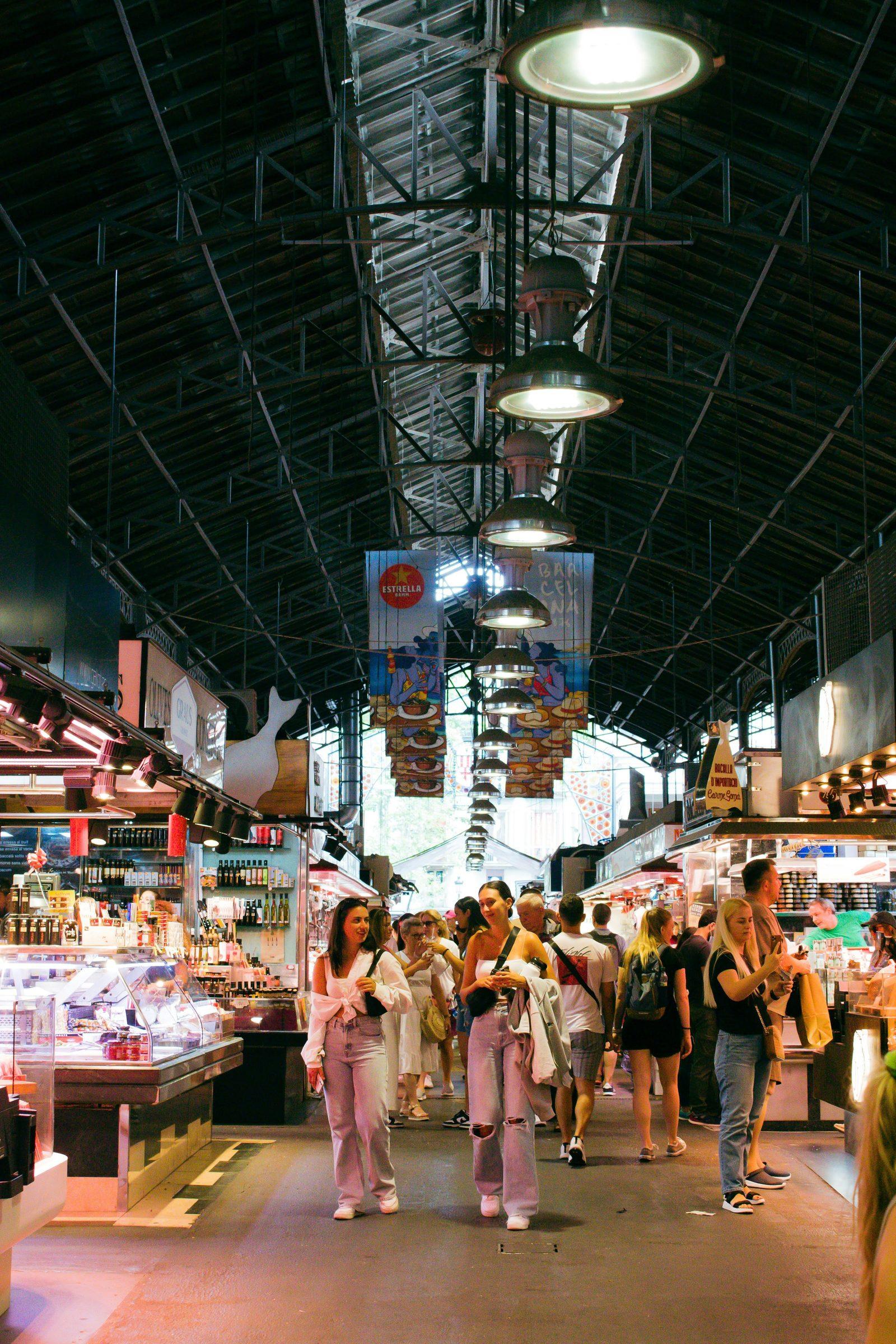
Mercat de la Boqueria is Barcelona's most photographed food market, its most overrun food market, and, if you know which stalls to walk past, still one of its genuinely great food markets.
The problem is the first thing visitors do. They walk in from Las Ramblas, see the first dozen stalls right at the entrance, photograph the fruit cups, buy a €6 paper cone of pre-cut mango, and conclude they've experienced the market. They've experienced the front row of the market, which is essentially a theme-park version of itself, priced and arranged for tourists who won't go any further.
The rest of the market, the part that locals actually use, is sixty seconds deeper in. This guide explains the layout, what to eat, where to find the good stalls, and how to spot the tourist traps without buying from them first.
The short answer:Walk past the first three rows of stalls. The good food is at the back of the market, the seafood, charcuterie, and the two stand-up bars where locals eat. Avoid the fruit cups at the entrance. Eat at Bar Pinotxo or El Quim if you can find a stool. Best time to visit is 9-10am or 2:30pm onward, when the tour groups thin out.
What La Boqueria actually is
The full name is Mercat de Sant Josep de la Boqueria. It's a covered municipal market dating to 1840 (the modern iron-and-glass roof went up in 1914) on the eastern side of Las Ramblas. It's still a real working market, fishmongers, butchers, fruit sellers, and a handful of tapas bars all operating side by side, just like the smaller neighborhood markets in Sant Antoni or Sants.
What's different about La Boqueria is its location. Being directly on Las Ramblas, the city's most touristic street, means the front of the market has, over the past two decades, been gradually colonized by stalls selling things designed for tourists rather than for cooks. Fruit cups, smoothies, ham cones, paper plates of cut fruit. None of which a local would ever buy here.
This isn't unique to La Boqueria. Every famous European food market goes through the same arc: working market → tourist destination → working market with a tourist front. The difference is that La Boqueria's tourist layer is thicker than most. You have to push past more theater to find the real thing.
The layout, decoded
The market is roughly rectangular, with the main entrance on Las Ramblas. Walking in from that entrance, you can think of it as four zones:
Zone 1, The first 15 meters from Las Ramblas (the tourist front): Fruit cups, ham-on-a-stick stalls, smoothies, candy displays. Beautiful for photos, terrible for eating. Prices are 2-3x what you'd pay at the back of the market or anywhere else in Barcelona. Skip everything here.
Zone 2, The middle rows (mixed): A blend of tourist-oriented stalls and legitimate ones. The visual quality is high (you'll be tempted) but pricing remains aggressive. Some good produce mixed with overpriced theater.
Zone 3, The back third (the real market): This is where locals shop. Fishmongers with the day's catch, proper butchers, dry-aged charcuterie, eggs sold by weight, mushroom specialists, olive sellers, and the two best stand-up bars, Bar Pinotxo and El Quim de la Boqueria. Prices drop sharply.
Zone 4, The far perimeter and side exits: A small cluster of additional bars and a few stalls that overflow from Zone 3. Often less crowded than the famous Pinotxo counter.
The single most useful piece of advice in this guide: walk straight in for 60 seconds without stopping. Don't photograph the fruit. Don't taste the ham. Get past Zone 1 before you start thinking about food.
Where to actually eat at La Boqueria
Bar Pinotxo
The famous one. A small horseshoe-shaped counter near the right side of the market (about 50 meters in from Las Ramblas), staffed by the late Juanito's family. You stand. You eat what they put in front of you. The standout dishes are the chickpeas with morcilla (blood sausage), the baby squid sautéed with onions, and the cap-i-pota (a Catalan beef-and-tripe stew that sounds challenging and tastes incredible).
The catch: you'll wait. Pinotxo seats maybe 12 people at the counter, and the line at peak times can be 30 minutes. It's worth it once, but only if you're willing to commit to the queue. Go at 9am if you want a seat without waiting.
El Quim de la Boqueria
The smarter pick if you don't want the queue and the Instagram pilgrimage. Run by chef Quim Márquez, located deeper in the market. The signature dish is huevos fritos con chipirones, fried eggs with baby squid, served over crisp potato. It sounds simple. It's transcendent. The eggs are perfectly runny, the squid have actual chew, and the potato underneath catches all the yolk.
El Quim also does more interesting daily specials than Pinotxo, fewer set classics, more "whatever the market has today" cooking. Smaller crowd, slightly faster turnover, equally great food.
Direct purchases from stalls
If you'd rather assemble a market lunch yourself rather than sit at a bar, this is where the back-third stalls become useful. Common moves locals make:
Charcuterie + bread. Buy 100g of jamón ibérico, some manchego, a few slices of fuet (Catalan dry sausage), and a small bottle of vermouth. Eat it on a bench outside or take it to your apartment. Cost: about €12 for a meal-sized portion.
Fresh fruit from a proper stall. The fruit stalls in Zone 3, the ones that look slightly less polished than the Zone 1 displays, are real fruit sellers. Cherries, figs in season, peaches, and the small sweet local oranges are reliably good and reasonably priced.
Olives from a specialist. The olive stalls (there are several) let you taste before buying. The Empeltre and Arbequina varieties, both Catalan, are what to ask for. Costs maybe €5 for 250g of premium olives.
Conservas. Tinned anchovies, tuna belly (ventresca), mussels in escabeche. The specialist stall near the back has Spanish conservas from small producers. A tin of good Cantabrian anchovies at €8 is one of the best souvenirs to take home.
What to avoid at La Boqueria
The fruit cups and smoothies at the front. Pre-cut fruit at €6 a paper cone is a deeply Spanish thing for tourists, but no Catalan eats this. The fruit isn't bad, but you're paying market-stall prices for grocery-store fruit pre-cut for someone too distracted to slice it themselves.
Anything labeled "jamón ibérico" being sold pre-sliced on a paper cone. Real jamón ibérico is sliced to order from a leg at room temperature. Pre-sliced ham at the front of the market is usually serrano (a lower grade) being sold at ibérico prices, or actual ibérico that's been losing flavor on display for hours.
The "spice mix" stalls. Pretty piles of multicolored powders in glass jars. They're tea-cozy versions of spices, blended for tourist appeal, marked up significantly. If you want actual saffron, buy from a proper saffron stall in Zone 3, and expect to pay €5-8 per gram for the real thing.
Any stall with a "Boqueria special" branded sign in English. Universal warning. Translated signage signals tourist pricing.
The €10 paella in a takeaway tray. It's microwaved. Paella is fundamentally a hot, fresh, made-to-order dish; the takeaway version is a sad approximation. Don't.
When to go (and when not to)
La Boqueria is open Monday to Saturday, 8am to 8:30pm. It's closed Sundays. The market is genuinely crowded most of the day, but there are calmer windows:
Best: 9-10am, when locals are doing their morning shopping and most tourists are still at breakfast. The fish and produce displays are at peak quality, and you can actually walk between stalls.
Also good: 2:30-4pm, when most tour groups have left for lunch and the afternoon shopping crowd hasn't arrived yet.
Worst: 11am to 2pm. Tour groups, cruise-ship visitors, Instagram pilgrims, all packed in at once. You'll spend more time waiting than eating.
Mondays: Many fishmongers don't operate or have minimal stock on Mondays because the fishing fleet doesn't go out on Sundays. If seafood is what you came for, go Tuesday through Saturday.
Avoid La Boqueria entirely during the first week of August, Barcelona is largely closed, market stallholders go on vacation, and the city becomes a hot, half-shuttered version of itself.
How to navigate without getting lost
The market has multiple entrances. The main one on Las Ramblas is the busiest and the tourist-trap-densest. If you want to skip Zone 1 entirely, enter from the back, there's an entrance on Carrer de Jerusalem that puts you directly into Zone 3. This is what locals do. It's also worth knowing if the front entrance becomes physically impassable, which happens in summer.
The stalls don't have street addresses; they have stall numbers. Bar Pinotxo is stall 466-470. El Quim is stall 583-584. If you Google these and look at the market map (the official Mercat de la Boqueria website has one), you can navigate directly.
If this all sounds like too much navigation
It is, a little bit. La Boqueria rewards visitors who already know the layout and who have specific things they want to eat. First-timers wandering in blind will usually default to the easiest option, the photogenic Zone 1 stalls, and conclude the market is overrated.
The shortcut is a guided market tour. A good guide takes you directly past Zone 1 to the back, walks you through the actual food culture, introduces you to specific stallholders, and helps you build a market lunch from the right places. We've featured a Barcelona market tour on the Barcelona food guide, it's the daytime option that includes a proper market visit alongside neighborhood food spots. The guide does the navigation for you.
For more on what to actually eat once you've found the good stalls, see our guide to the 15 dishes worth prioritizing in Barcelona. Most of them appear, in some form, at La Boqueria.
Get the free Barcelona food guide
Eight pages: the 15 dishes worth ordering, the phrases that get you served properly, and where to eat by neighborhood. Print it or save it offline for the trip.
One final note on photography
The market is beautiful. The displays are vivid. Tourists photograph everything. Locals find this somewhere between irritating and acceptable, depending on how aggressive the photography becomes.
The unspoken rule: photograph the produce, the stalls, the architecture, the general scene. Don't photograph stallholders' faces without asking. Don't photograph close-ups of the cooked food at Pinotxo or El Quim while people are eating. Don't block the aisles to get a shot. The market is a working space; treat it like one.
Locals notice the difference between tourists who photograph respectfully and those who don't. The former get warmer service. The latter get charged the highest price on the menu.