
Some links in this article are affiliate links. If you book through them we may earn a small commission, at no extra cost to you. We only recommend experiences we'd send a friend to.
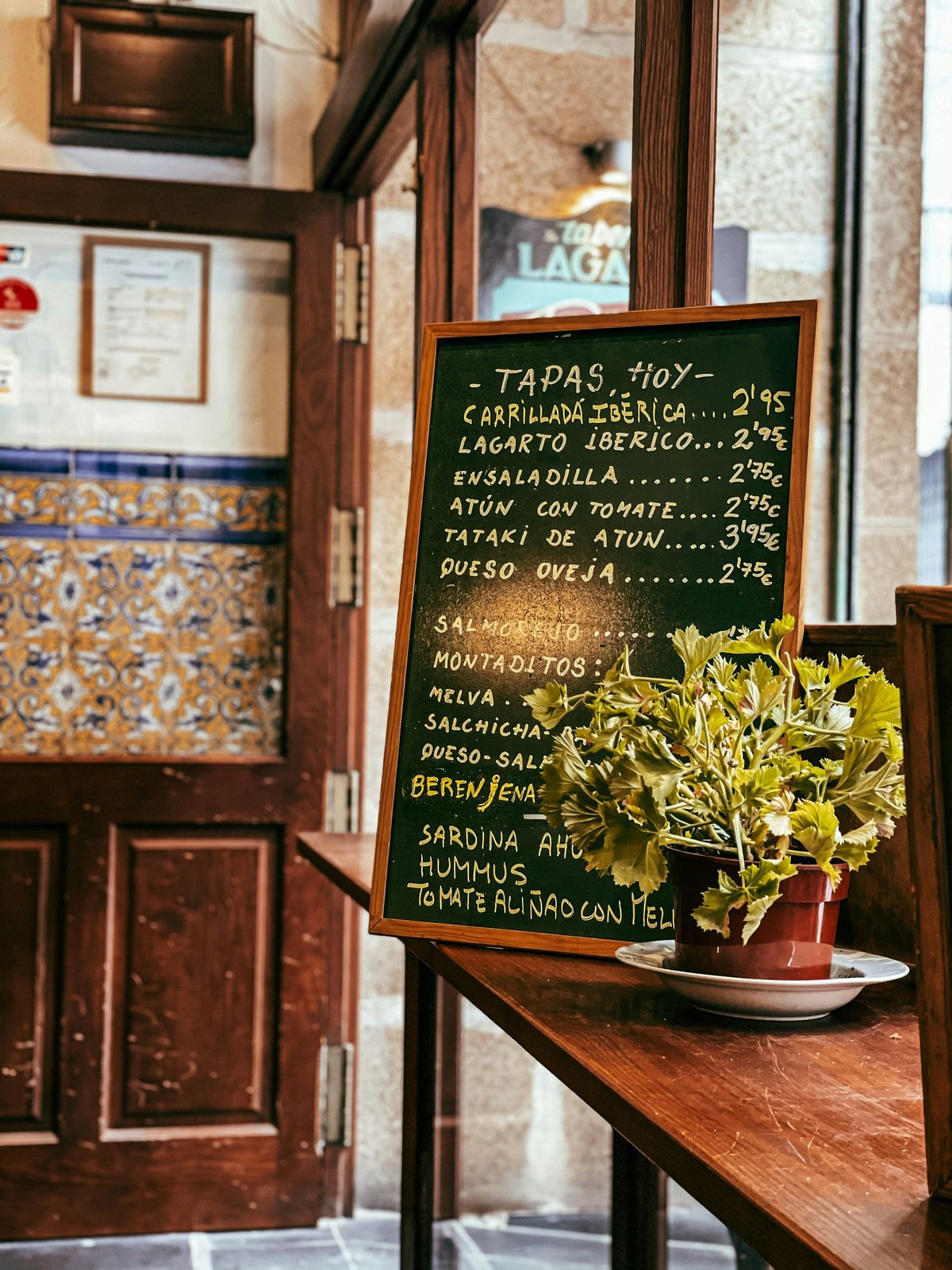
You walk into a Spanish bar at 9pm. It's loud. The bartender is fast. There's a blackboard on the wall with seven items in handwritten Spanish you can't quite read. The locals around you are calling out orders without making eye contact. You have approximately four seconds to either look like you know what you're doing, or freeze.
This is the moment this article exists for.
Spanish tapas bars run on a quick verbal shorthand that takes about ten minutes to learn but is rarely explained anywhere. Most guides will tell you what tapas is, very few will tell you how to actually order them. So here are the phrases, the customs, and the small things that signal "this person has done this before" instead of "this person needs a tourist menu in English."
The short answer:To order anything, say "Me pones [X], por favor" ("Could you give me [X], please"). To get the bartender's attention, say "¡Perdona!", not "hola" and not waving. To pay, raise your hand slightly and say "La cuenta, por favor." Master those three phrases and you can survive any bar in Spain.
Ordering vocabulary, the four phrases that do everything
Spanish bar ordering uses a small set of constructions. Once you know these, you can build almost any order.
"Me pones..." (literally "you put me..."), the default ordering phrase. Used by most Spaniards, every day, in every region.
Example: "Me pones una caña, por favor." (Could you give me a small beer, please.)
"Ponme...", the slightly more direct, informal version of the same thing. Common among older Spaniards and in working-class bars. Both are perfectly polite; the difference is roughly equivalent to "could you give me" vs "give me." Neither is rude.
"Quería..." (literally "I wanted"), sounds odd in English but it's the standard polite way to order. Spanish uses the imperfect tense here as a softener, the same way English speakers say "I'll have..." when they mean "I want now."
Example: "Quería una caña y unas bravas." (I'd like a small beer and an order of patatas bravas.)
"Para mí..." (literally "for me"), used when ordering as part of a group, especially when the bartender is going around the table or counter taking individual orders.
Example: "Para mí, una croqueta." (For me, a croquette.)
You can also just point at the blackboard or display case and say the name of the dish. That works. The phrases above just make you sound like you've ordered tapas before.
How to call the waiter (without being rude)
This is the part most non-Spanish-speakers get wrong, and the part that immediately marks you as a tourist. Here's how locals actually do it.
Use "Perdona" or "Perdone." Both mean "excuse me", "perdona" is informal (with younger bartenders or in casual bars), "perdone" is formal (with older waiters or in more upscale places). When in doubt, "perdona" is fine almost everywhere.
Make brief eye contact, raise a finger slightly. No waving, no snapping, no clicking. The hand goes up a few inches, the eyes meet the bartender's for a second, you say "perdona." That's it.
Don't say "Camarero!" (waiter). Yes, you'll see this in old phrasebooks. No, Spaniards don't actually shout it. It sounds either condescending or like a 1970s movie. Same goes for "señor" or "señorita." Just "perdona."
Don't say "hola." "Hello" doesn't summon a waiter. It just greets them. They'll smile and say "hola" back, and you'll still be sitting there with no drink.
Be patient. Spanish bartenders are extremely fast at the bar but they work on a queue system in their head. If they've seen you raise your hand, they know you're next. Don't try to flag them down repeatedly. It reads as impatient. The wait might feel long but it's almost never longer than 60-90 seconds.
Vocabulary by category
Memorize these and you can read most blackboard menus and call out orders confidently.
Drinks
Una caña, a small draft beer (200ml). The default beer order in Spain.
Una jarra, a pint of draft beer (500ml). Less common than a caña; usually drunk during meals.
Un tercio, a 333ml bottled beer. The standard bottled option.
Un quinto, a 200ml mini-bottle. Same as a caña but bottled.
Una clara, beer mixed with lemon soda. Refreshing in summer, looked down upon by serious beer drinkers.
Un vermut, vermouth (on the rocks, with olive and orange slice). The classic pre-lunch drink.
Una copa de vino, a glass of wine. Specify tinto (red), blanco (white), or rosado (rosé).
Una copa de cava, a glass of cava (Catalan sparkling wine).
Un café solo, espresso. Cortado is espresso with a splash of milk. Con leche is with more milk.
Una botella de agua, a bottle of water. Specify sin gas (still) or con gas (sparkling).
Tapa sizes
Una tapa, a small portion, usually one or two bites. The default size.
Una media ración, half a plate, enough for 2-3 people to share a few bites each.
Una ración, a full plate, meant for sharing among 3-4 people.
Un pincho / pintxo, a single bite-sized portion, usually served on a skewer or piece of bread. The Basque-country word for tapa. You'll see it most in San Sebastián and the north.
Un montadito, a small open-faced sandwich on a slice of bread. Common in Andalusia.
A useful tip: if you're hungry and want to try several things, order all tapas. If you're at a table with friends and want to share, order raciones. Mixing the two confuses the kitchen.
How many tapas per person?
The most-Googled question about tapas. Practical answer: 3-4 tapas per person if tapas is the meal, or 1-2 per person if it's a pre-dinner snack. Two people sharing 6-8 tapas plus drinks is a normal dinner. Four people sharing two raciones plus a few tapas is also normal.
Spaniards typically don't order everything at once, they order 2-3 things, eat them, then order more. This is why the bartender comes back. Don't feel like you need to pick everything in one go.
Payment
La cuenta, por favor, "The bill, please."
¿Cuánto es?, "How much is it?" (for small orders paid at the bar)
¿Aceptan tarjeta?, "Do you accept card?" (almost always yes in cities, sometimes no in smaller bars)
Pago yo, "I'll pay" (used when splitting or covering for friends)
Vamos a medias, "Let's split it"
In most casual bars, you can either pay at the table when leaving, or pay at the bar when you finish your drink. Watch what locals do, both are normal.
Real ordering scripts
Here's how a real order sounds, start to finish, in different situations.
Solo at a bar counter, just starting
You: "Hola, ¿qué tal?" (Hi, how's it going?)
Bartender: "Bien, ¿qué te pongo?" (Good, what can I get you?)
You: "Me pones una caña y una tapa de tortilla, por favor." (A small beer and a tapa of tortilla, please.)
Bartender: "Marchando." (Coming up.)
"Marchando" literally means "marching" but in bar slang means "on its way." You'll hear it constantly. No reply needed.
At a table with friends, ordering several things
You: "Perdona, ¿nos pones una ración de bravas, una media de pulpo, y tres cañas?" (Excuse me, could we have a ración of patatas bravas, a half-ración of octopus, and three small beers?)
Waiter: "¿Algo más?" (Anything else?)
You: "De momento nada, gracias." (Nothing for now, thanks.)
"De momento", "for now", is a useful phrase. It signals that you might order more later, which is exactly what Spaniards do.
Asking what's good
If you can't read the blackboard or want a recommendation:
You: "¿Qué me recomiendas?" (What do you recommend?)
Or: "¿Cuál es la especialidad de la casa?" (What's the house specialty?)
Spaniards genuinely use these phrases, they're not just textbook Spanish. Bartenders almost always have an opinion and will steer you toward what the kitchen does best. This is one of the easiest ways to eat well in Spain.
Paying and leaving
You: "¿Me cobras, por favor?" (Could you charge me, please?), or "La cuenta, por favor." (The bill, please.)
Bartender: "Son doce con cincuenta." (That's €12.50.)
You: "Aquí tienes. Gracias, hasta luego." (Here you go. Thanks, see you later.)
Bartender: "A vosotros. ¡Hasta luego!" (Thanks to you. See you later!)
"Hasta luego" is the standard goodbye, even if you'll never see them again. "Adiós" sounds slightly more final and is used less often in casual contexts.
The unwritten rules
These are the small things that distinguish "tourist who memorized phrases" from "person who's done this before."
Don't over-thank. English speakers, especially Americans and British, say "thank you" two or three times per interaction. Spaniards find this slightly weird. One "gracias" when receiving something, one at the end. Don't thank the bartender every time they put down a plate.
Don't tip heavily. Spain isn't a tipping culture. Rounding up to the nearest euro or leaving the small change is generous. Leaving 15-20% American-style is unnecessary and slightly awkward, bartenders aren't expecting it. The exception is sit-down restaurants for a long meal, where leaving 5-10% is appreciated but still not expected.
Stand at the bar if you're just having a couple of drinks. In most Spanish bars, drinks are cheaper at the bar than at a table. Locals often stand at the counter even when tables are free. There's no shame in this, it's how the whole system works.
Pa amb tomàquet is bread, not a tapa. In Catalonia, the bread with crushed tomato that arrives at your table is almost always free or charged as bread service (€1-2). You don't need to order it as a tapa. Same with olives or chips that arrive with your drink, these are usually free in traditional bars.
Don't ask for splitting plates separately if you're sharing tapas. Tapas are designed to be shared from the center of the table. Asking for individual plates marks you as a tourist. Use the bread to push food onto a small plate if you must.
Lunch is at 2pm, dinner is at 9-10pm. If you arrive at a tapas bar at 6pm hoping for dinner, you'll find some places closed and others empty. The rhythm of Spanish eating is non-negotiable. We've written about this rhythm in more detail here, it's worth understanding before you arrive.
What never to say
A short list of phrases that will mark you immediately as someone who learned Spanish from a phrasebook, not a bar.
"Yo quiero..." ("I want..."), Technically correct, used by Spanish learners worldwide, and somehow always sounds slightly off in a bar context. Use "me pones" or "quería" instead.
"¡Camarero!", See above. Never shouted in modern Spain except in jokes.
"Una sangría", Spaniards don't actually drink sangría. It exists, but mostly as a drink served to tourists. Ordering it in a serious bar marks you instantly. (If you want fruity wine, order tinto de verano instead, it's the Spanish summer drink, red wine with lemon soda, drunk by everyone.)
"Paella for one", Real paella is made fresh for a minimum of two people, takes 30+ minutes to cook, and is served at lunch, not dinner. A "paella for one" served quickly in the evening is reheated rice. Skip it.
"Tapas menu in English, please", Most bars have one. Most are also bad translations and miss half the daily specials chalked on the blackboard. Ask for "la carta" (the menu) and try to read the Spanish version, even if you only understand half, the dishes you recognize are usually the best ones.
Regional variations to know
Spain isn't linguistically uniform. A few quick regional notes:
Catalonia (Barcelona): Many bartenders speak Catalan with each other and Spanish with customers. You don't need Catalan to order, but recognizing it helps. "Si us plau" means "please" in Catalan; "gràcies" means "thanks." Both are appreciated even from foreigners.
Basque Country (San Sebastián, Bilbao): Tapas are called pintxos here. The ordering culture is different, many bars display pintxos on the counter and you grab what you want, then tell the bartender what you had at the end. More on this in our Barcelona vs San Sebastián guide.
Andalusia (Seville, Granada, Córdoba): Tapas are often free with a drink in Granada, order a beer, get a tapa thrown in. In Seville, you'll see "montaditos" (small open-faced sandwiches) more often than in other regions.
Galicia (Santiago, A Coruña): Slightly different drinking culture, wine is poured into small white cups called cuncas rather than glasses. The local octopus dish (pulpo a la gallega) is one of Spain's great regional specialties.
Get the free Spain food guide
Six pages to keep on your phone: how tapas and pintxos work, the phrases that get you served, and what to eat in Madrid, Barcelona and San Sebastián.
If you forget everything
The minimum viable Spanish for surviving any tapas bar:
"Hola, perdona, ¿me pones una caña y esto, por favor?" [point at something on the menu] "Gracias."
That's it. "Hi, excuse me, could you give me a small beer and this, please?" + pointing at any dish. Will work in every bar from Bilbao to Granada. You'll order something good, drink something cold, and pay €5-8 for the experience.
Spanish bar culture is forgiving, locals will help you the moment they realize you're trying. The point of learning the phrases isn't to pass as Spanish; it's to participate in the culture instead of standing outside it.
For more on what to actually order once you can order it, see our guide to Spanish dishes worth trying. For the cultural context behind the ritual, when to eat, where to go, how long to stay, our guide to how tapas work in Spain covers the bigger picture.