
Some links in this article are affiliate links. If you book through them we may earn a small commission, at no extra cost to you. We only recommend experiences we'd send a friend to.
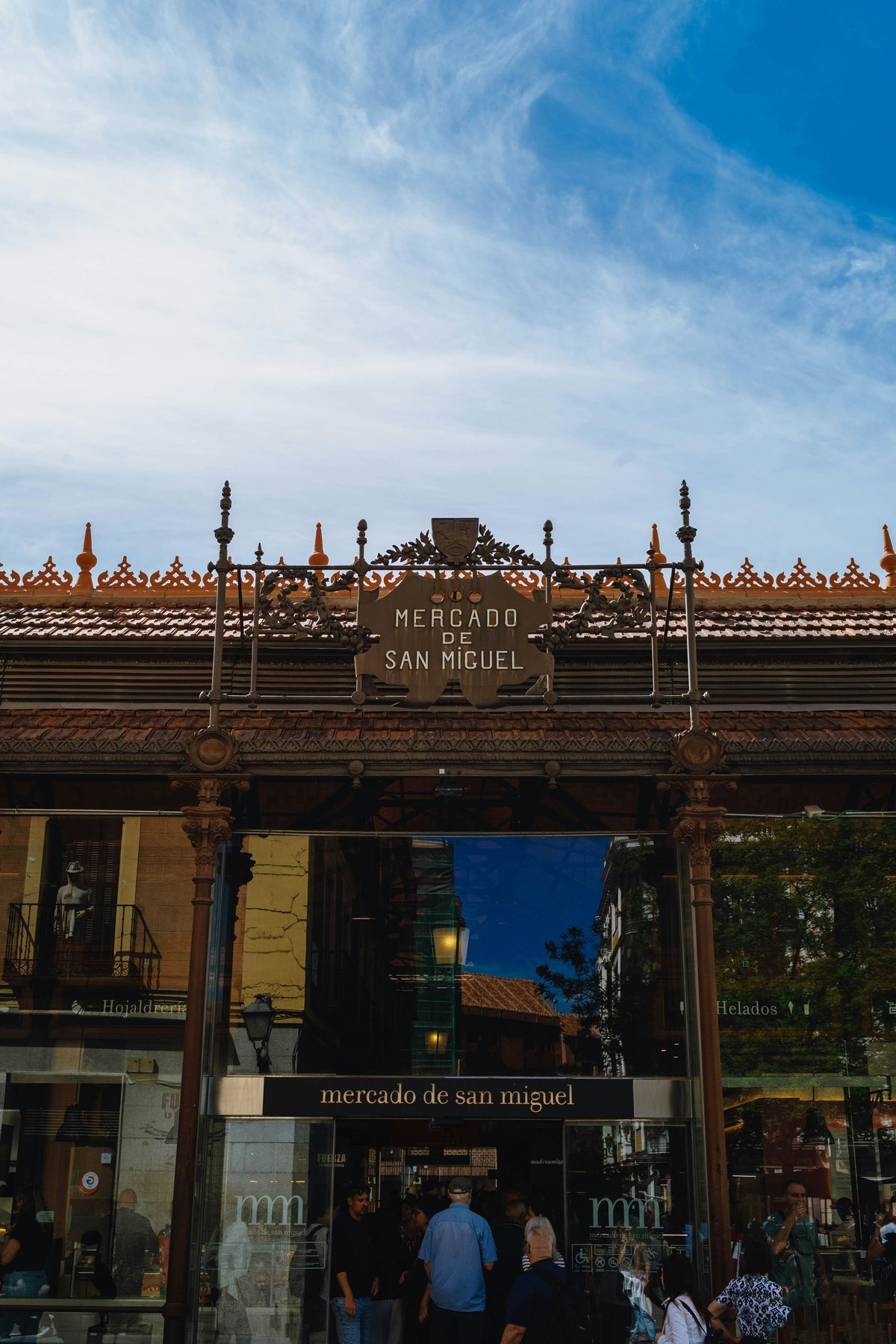
Mercado de San Miguel is where most visitors to Madrid end up within a day of arriving, often when it's at its busiest. It's worth an hour of your trip, and the hour you pick matters more than anything you order.
It deserves the visit. The building is beautiful, it's free to walk in, and having dozens of Spanish specialties under one roof is useful when you want to try a lot of things in small amounts. Most disappointing visits come down to timing and expectations: a packed weekend evening, a queue at every stall, nowhere to stand, and a snack stop treated as dinner.
The short answer:Go between 10am and noon on a weekday. Allow about an hour and roughly €20 to €30 each. Eat jamón ibérico, oysters with a glass of cava, and croquetas that have just come out of the fryer. Order things sliced or fried in front of you, and don't make it your dinner. If you want a guide, the €52 street food tour is the one that spends the most time inside the market.
What it actually is
San Miguel is a food hall. You can't buy vegetables or fish to cook at home here, and it isn't a neighborhood market like the ones in La Latina or Chamberí. Since its 2009 renovation, the iron-and-glass building from 1916 has housed more than thirty stalls selling ready-to-eat food and drink: jamón, oysters, croquetas, cheese, vermouth, seafood, even a paella stand. You buy at each counter and eat standing at ledges. There are very few seats.
If you've been to Borough Market in London or the Time Out Market in Lisbon, it's the same idea. Prices are set for visitors, which is what you'd expect two minutes from Plaza Mayor.
When to go
The market's website lists opening hours of 10am to midnight from Sunday to Thursday, and 10am to 1am on Fridays, Saturdays and the night before a public holiday (checked 24 October 2026). Hours can change around Christmas, New Year and private events, so check the site before you plan a visit around those dates. Individual stalls keep their own hours inside those times.
I'd go on a weekday morning. The reasoning is simple: the crowds that make this place hard work are tour groups, people on their way to dinner and weekend visitors, and none of them are here at 11am on a Tuesday. You can reach the counters and take your time choosing.
Weekend evenings are the time to avoid. That's when the market is busiest, and with very few seats, finding a ledge to eat at is harder than getting served.
Sunday mornings bring the crowd from El Rastro flea market, a few minutes' walk away, so expect it to be busy then too.
What to eat
The market's website lists more than thirty stalls, and the line-up changes. The stall names below are from that list on 24 October 2026. What follows is my reasoning about what's worth ordering in a place like this, not a report from a meal at each counter, so check the stall is still there when you arrive.
Jamón ibérico
Start here. MAS Gourmets / Carrasco Ibéricos sells jamón by the plate. Look for ibérico de bellota, the top grade, from acorn-fed pigs; the cheaper cebo grade comes from grain-fed pigs. If you're going to eat ibérico once in Madrid, pay for bellota. It's the dish a hall like this does best, because it's sliced to order and needs no kitchen.
Oysters and cava
Daniel Sorlut, a French oyster producer, has a bar here, and oysters with a glass of cava are one of the easiest things to enjoy standing up. Skip it if you don't like oysters.
Croquetas
Arzábal, a Madrid restaurant group known for its croquetas, has a croquetería in the market. Croquetas are only as good as how recently they were fried, so watch the fryer and order when a batch comes out.
Cheese and vermouth
Quesoba does Spanish cheeses, an easy way to try manchego or torta del Casar without ordering a full board at a restaurant. For a drink, La Hora del Vermut pours the classic red vermouth, usually served with an olive and a slice of orange.
The calamari sandwich
The bocadillo de calamares, fried squid rings in a soft roll, is Madrid's signature sandwich. You can get one in the market, and it's a reasonable way to try it. If you have time, though, the old bars by Plaza Mayor, La Campana and Bar La Ideal among them, are the classic setting, and the walk is a few minutes.
Order with care
Two things I'd treat with care. Anything pre-assembled and lined up on display has usually been made well ahead, so order things that are sliced, opened or fried in front of you. And there's a paella stand from the chef Rodrigo de la Calle. I've lived in Valencia for years and I'm picky about paella, so I'd save it for Valencia, but that's my bias, and a chef's stand is a better bet than most paella in central Madrid.
How much to budget
These are rough estimates, not prices checked at each stall: about €15 to €25 each gets you a plate of jamón, a drink and one other bite. €25 to €40 covers two or three small plates, say jamón, oysters and cheese, with a couple of drinks. Past €40 you're making a meal out of snacks, and you'd probably eat better sitting down in La Latina.
You pay at each stall separately. Most take cards, but small cash helps for a single croqueta.
Where it fits in a day
Treat San Miguel as the first stop of a morning in central Madrid. Arrive at 10:30 or 11, eat for an hour, then walk through Plaza Mayor to Cava Baja in La Latina, about ten minutes away, and sit down for lunch in a proper tavern. If you'd rather have something sweet, San Ginés for chocolate and churros is a few minutes from the market in the other direction.
For the neighborhood next door, our guide to La Latina food tours covers Cava Baja, El Rastro and the four tours worth booking there. It is a five-minute walk from the market and a completely different experience.
Other markets nearby
Mercado de San Antón (Chueca) is a working market with food stalls downstairs and tapas bars upstairs. It's central, about fifteen minutes' walk from Puerta del Sol, and draws fewer tour groups than San Miguel.
Mercado de San Fernando (Lavapiés) is a neighborhood market where fruit stalls and butchers still sit alongside the bars. It's scruffier and much less polished, about twenty minutes from Sol.
Mercado de la Paz (Salamanca) is an upscale local market and home to Casa Dani, a bar known for its tortilla. Take the metro to Serrano and walk three minutes.
Seeing San Miguel with a guide
A guide is useful here mainly because the market is so easy to waste money in. What matters when you pick a tour is how much of it actually happens inside the market. On the three below, that runs from half an hour to none at all.
Details below come from each tour's listing, linked under it, and from recent reviews on Viator and Tripadvisor, including the low-rated ones, read on 24 October 2026. Prices are per person.
Madrid Street Food Tour, from €52
4.8 stars, 104 reviews, about 2 hours, max 10 people.
The one to book if the market is the point, and the cheapest of the three. It starts inside San Miguel, with about half an hour tasting cheese and a small tapa at the stalls with a glass of wine. Then it heads out past Plaza Mayor for the calamari sandwich, a visit to a traditional chocolate maker, and churros with chocolate, finishing at Puerta del Sol. Jose leads most of them and fits a lot of history in between stops. Groups are often tiny, and there's a vegetarian option at every stop.
The weak spot is the amount of food. The market tastings are small, a slice of cheese and a little toast, and it's more of a walk with snacks than a feast. Eat a proper lunch afterwards. You meet outside the Starbucks on Calle Ciudad Rodrigo, just off Plaza Mayor.
Madrid Tapas & Wine Tasting, from €79
4.9 stars, 5,465 reviews, about 3 hours, max 12 people.
This one never goes near San Miguel. It's an evening of four bars in the Barrio de las Letras, starting at the Lorca statue in Plaza de Santa Ana, with twelve tapas shared across the group and a drink at each stop. That is enough for dinner. If you'd rather wander the market on your own in the morning and spend your guided time in ordinary Madrid bars, book this instead. It's the most reviewed food tour in the city by a long way.
Know two things before you book. The food comes as shared plates for the whole group, which some people love and others find awkward with strangers. And the wine pours are small.
Local Tapas, Beer and Wine, from €115
5.0 stars, 11 reviews, about 3 hours.
Four stops: Plaza de Santa Ana, a bar near Sol, the calamari sandwich by Plaza Mayor, and a final tapa inside San Miguel with free time to explore once the tour ends. Arriving at the market last, already fed, is a good way to see it. It's also the only one of the three listed as wheelchair accessible.
It costs more than twice the street food tour, though, and with eleven reviews and none of them recent, it doesn't have much of a track record yet. Book it if step-free access matters to you or you want the market at the end of the evening.
Prices, ratings and review counts checked on each listing on 24 October 2026. For every Madrid option compared side by side, see the best food tours in Madrid.
Get the free Spain food guide
Six pages to keep on your phone: how tapas and pintxos work, the phrases that get you served, and what to eat in Madrid, Barcelona and San Sebastián.
After the market
Our Madrid food guide covers the tours worth booking in the rest of the city. Before your first night out, how tapas work explains the rhythm of a Madrid evening, and our guide to ordering tapas in Spanish covers what to say once you're at the bar.