
Some links in this article are affiliate links. If you book through them we may earn a small commission, at no extra cost to you. We only recommend experiences we'd send a friend to.
The Basque cheesecake you have seen on every bakery menu from London to Seoul is usually sold as "burnt." The one it copies, from a crowded bar in San Sebastián's old town, is not burnt at all. That single misunderstanding explains most of what goes wrong with it everywhere else.
This is a guide to what a good one should actually be like, so you can tell the real thing from an imitation, and to the places in San Sebastián where it is still made properly.
The short answer:A good Basque cheesecake has a deep golden or dark caramel top, not a black one, no biscuit base, and a soft, creamy center that slumps when you cut it. Eat it at room temperature. The original is at La Viña in San Sebastián, and for a quieter version locals point to Bar Sport and Bodega Donostiarra.
Where it came from
La Viña is a pintxos bar on Calle 31 de Agosto in the Parte Vieja, San Sebastián's old town. It opened in 1959, run by the Rivera family, and it was a well-liked local bar long before anyone outside the city had heard of it.
Santiago Rivera, who grew up in the restaurant, started experimenting with a cheesecake in the late 1980s. After a few years of testing it went on the menu around 1990, as nothing grander than the house dessert. In San Sebastián it is still mostly called tarta de queso, or simply the one from La Viña. The word "burnt" is mostly something the rest of the world added.
It stayed a local secret for years, then travelers, chefs and food writers found it, and in the 2010s it spread across the globe, through Turkey and Asia first and the United States after. Today it is one of the most copied desserts there is.
What makes a good one
The recipe is short: cream cheese, eggs, sugar, cream, and a very small amount of flour, baked hot and fast in a pan lined with parchment. Because there is so little in it, every detail shows. Here is what to look for.
1. A golden top, not a black one
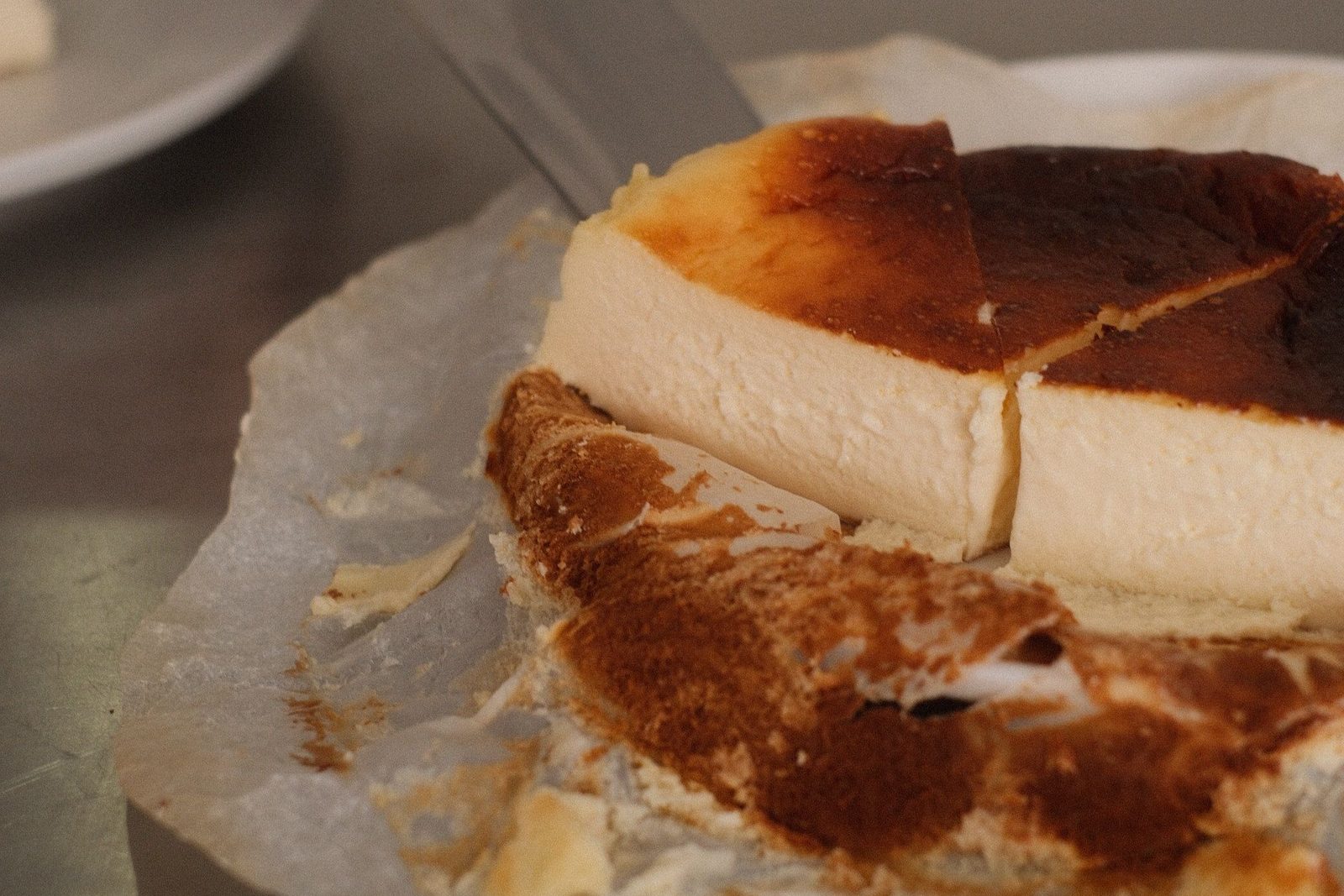
This is the big one. The top should be a deep golden brown to dark caramel, the color of well-toasted bread or burnt sugar on a crème brûlée. It should taste of caramelized sugar.
It should not be charcoal black. At La Viña they deliberately do not burn it, because burning makes it bitter, and bitterness is a flaw rather than a feature. A lot of imitations, chasing the word "burnt," take it much too far and end up with an acrid crust over the cake. If the top tastes of smoke, it has gone wrong.
2. No biscuit base
A Basque cheesecake has no crust underneath. That was a deliberate choice: the idea is a cake that melts in your mouth with nothing to chew. If you are served one sitting on a crumbly base of crushed biscuits, it is a different cake that has borrowed the name.
3. A soft, creamy middle
Cut into a good one and the center should be noticeably softer than the edges. Creamy, custardy, only just set, slumping slightly toward the plate. The outer ring is firmer; the heart is close to molten.
This contrast is the whole point, and it comes from baking at very high heat for a short time, so the outside cooks and caramelizes while the inside barely sets.
4. Smooth and light, not dense
The texture should be smooth and almost airy on the tongue. If it is heavy, chalky, or cuts cleanly like a block, something is off. The usual culprit is too much flour added for stability, or baking too low and slow, which produces what is really a crustless New York cheesecake.
5. Served at room temperature
A properly made Basque cheesecake is at its best at room temperature, when the center is soft and the flavor is fully open. Straight from the fridge it firms up and goes quiet. If yours arrives cold and stiff, it has been stored like an ordinary cheesecake.
6. It tastes of cheese, not decoration
Lightly sweet, with a gentle savory tang from the cheese and a caramel note from the top. That is it. Flavored versions with pistachio, chocolate or dulce de leche can be fun, and plenty of good places make them, but if the cake only works because of what is poured over it, the cake itself is not the point any more.
7. Rough edges are correct
Do not be put off by a cake that looks a mess. A real one is baked in folded parchment and sinks as it cools, so it comes out cracked, rumpled and collapsed at the sides, with the creases of the paper still visible. Perfectly smooth, straight sides usually mean a different method entirely.
How to spot a bad one, quickly
- A black, smoky, bitter top.
- A biscuit or graham-cracker base.
- Firm and dense all the way through, with no soft center.
- Served fridge-cold.
- Neat, smooth, perfectly straight sides.
- So much sauce on top that you cannot taste the cake.
Where to eat it in San Sebastián
A note before the list: restaurants change, and some of these get very busy, so check opening hours before you make a special trip.
La Viña, the original
Calle 31 de Agosto, 3, in the Parte Vieja. This is where it started and it is still the reference point everyone else is measured against. Walk in and you will see finished cakes stacked on the bar and empty pans lined up waiting for the next batch.
Be realistic about the experience. It is loud, cramped and mobbed, and because it now turns out cakes in enormous volume, some visitors say it has lost some of its charm. That is a fair criticism of the room. The cake is still the one that defined the dish, and if you care about cheesecake at all you should eat a slice of the original at least once.
Go mid-afternoon or early evening, before the pintxos crowd peaks, and share a slice, because it is richer than it looks.
Bar Sport, the rival
Also in the Parte Vieja, and the name that comes up most often when locals are asked where to go instead. Bar Sport is a proper pintxos bar first, but its cheesecake is regularly described as the one that rivals La Viña's. No reservations, so treat it as part of an evening crawl rather than a destination dinner.
Bodega Donostiarra, the locals' choice
In Gros, across the river from the old town, and going since 1928. Its cheesecake is noticeably different: a firmer, slightly crumbly edge, a dense and very creamy interior, more vanilla, and a gentler scorch on top than La Viña's. If you want to taste how much the style can vary, eating this the day after La Viña is the best comparison you can make.
Narru, the refined version
In the Centro district. A Michelin-recommended restaurant rather than a pintxos bar, and its cheesecake is the dish taken to its most precise, with a focus on exact texture. Book a table and have it at the end of a proper meal.
Casa Otaegui, the bakery
A long-established pastry shop in the old town, if you want a slice to take away rather than a bar experience. Its version leans firmer and more traditional, which suits people who find the molten style too much.
The one you cannot have any more
For decades the other famous cheese tart in the region was at Zuberoa, Hilario Arbelaitz's Michelin-starred restaurant in a centuries-old farmhouse outside the city. It closed in December 2022. Chefs in San Sebastián still mention it with something close to reverence, and some make their own homage to it, so if you see a version described that way, that is what it refers to.
Get the free Spain food guide
Six pages to keep on your phone: how tapas and pintxos work, the phrases that get you served, and what to eat in Madrid, Barcelona and San Sebastián.
Beyond San Sebastián
The Basque style set off a national obsession with tarta de queso, especially the runny, barely-set kind Spaniards call fluida. One of the best-known modern versions comes from Cañadío, a restaurant that started in Santander and has since opened in Madrid. If you are heading to Madrid next, it is a good way to taste where the idea went after it left the Basque country, and it fits neatly into a day of eating in Madrid.
How to fit it into a trip
Treat cheesecake as the last stop of a pintxos evening rather than a separate outing. Work your way round the Parte Vieja, eat standing up at a few bars, and finish at La Viña or Bar Sport with a slice to share.
If you would rather someone walked you round the old town and showed you which bars are worth it, this is the pintxos tour I send people to. It makes five stops in the Parte Vieja, and the last one is cheesecake with a sweet sherry at La Viña.
Old Town Pintxos & Wine, from €103
Price checked 19 September 2026, per person. More options in the best pintxos tours in San Sebastián.
More on San Sebastián: the full city food guide, what to eat in San Sebastián, the best pintxos tours, and Rioja wine day trips from the city. Still choosing where to go? Try Barcelona vs San Sebastián.