
Christmas in Spain is long. It starts with the markets at the end of November and doesn't finish until the roscón on the 6th of January, and most of the eating in between happens at home, around family tables you won't be sitting at.
So for a visitor, the question isn't what Spaniards eat at Christmas. It's what you can eat, where, and on which day. Some of the best of it is sold over a shop counter. Some of it is only on menus for a single day of the year. And on one night, the 24th, you'll need a plan.
The short answer:Turrón and polvorones are everywhere from December; buy turrón by the slice at Casa Mira in Madrid. In Barcelona, eat escudella on Christmas Day and canelons on the 26th. In San Sebastián, go to Santo Tomás on the 21st for txistorra in a corn talo with cider. Finish with roscón de reyes on the 6th of January. And book Christmas Eve dinner early, because many restaurants close that night.
| When | What | Eat or see |
|---|---|---|
| Late Nov to Christmas | Fira de Santa Llúcia, Barcelona | Christmas fair in front of the cathedral |
| Late Nov to 31 Dec | Christmas market, Plaza Mayor, Madrid | Stalls of nativity figures and decorations |
| 21 December | Santo Tomás, San Sebastián | Txistorra in talo, and cider |
| 24 December | Nochebuena | The big family dinner. The hardest night to eat out. |
| 25 December | Navidad | Escudella i carn d'olla in Catalonia |
| 26 December | Sant Esteve, Catalonia | Canelons made from the Christmas roast |
| 31 December | Nochevieja | Twelve grapes at midnight |
| 6 January | Reyes | Roscón de reyes |
The sweets you'll find everywhere
From early December, every bakery, supermarket and corner shop in Spain fills up with the same handful of Christmas sweets. They're the easiest part of a Spanish Christmas to join in with, because you don't need an invitation, only a shop.
Turrón
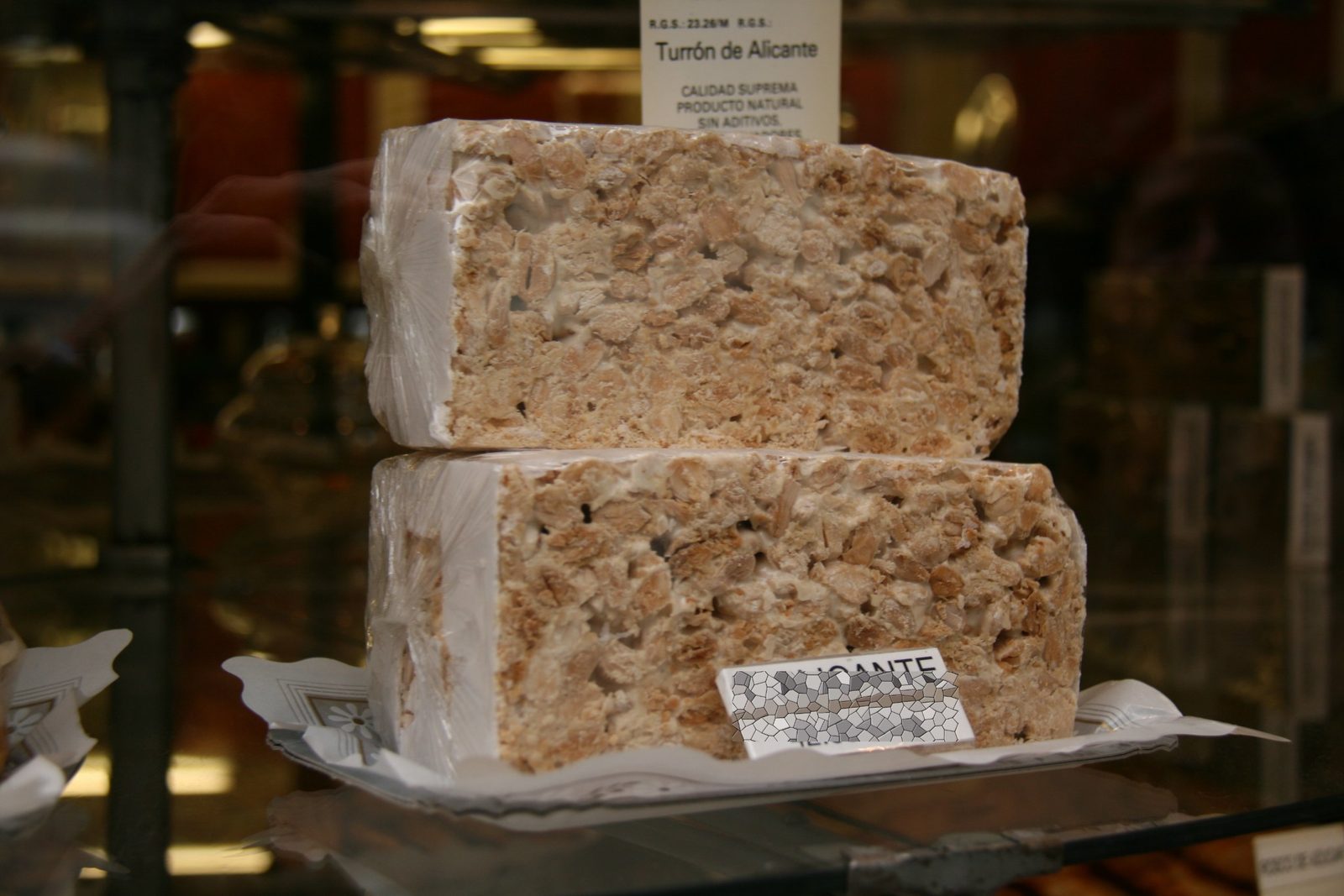
Almond nougat, and the one that matters most. It's a medieval sweet that most likely started in the south of Valencia province, around Jijona and Alicante, and those two names are still the two classic styles. Alicante turrón is hard, with whole almonds set in honey and egg white. Jijona is soft, the almonds ground to a paste. Beyond those you'll find egg yolk, chocolate, fruit and a lot of modern variations.
In Madrid, the place to buy it is Casa Mira on Carrera de San Jerónimo, a few minutes from Puerta del Sol. Luis Mira came to Madrid from Jijona in 1842 and the shop has been on this street since 1855, run today by the sixth generation of his family. They sell it by the slice, so you can try several. Lhardy, on the same street, makes its own too.
Polvorones and mantecados
Crumbly shortbread made with flour, ground almonds and lard, usually wrapped individually in paper. They fall apart in your mouth, which is the point. You'll see Estepa, a town in Andalusia, on a lot of the packets.
Neules
The Catalan one. Thin rolled wafers, crisp and lightly lemony, eaten after the big Christmas meal and dipped in cava. They're old: a Christmas dinner for King Jaume I mentions them in 1267.
Madrid
Madrid's traditional Christmas table is fish and red cabbage. Besugo al horno, oven-roasted sea bream, became the capital's Christmas fish because it survived the journey inland from the coast, and it's served with lombarda, braised red cabbage. For dessert, alongside the turrón, there's sopa de almendras, a sweet almond soup that's a Madrid Christmas tradition.
On the 6th of January the city switches to roscón de reyes, a ring of sweet dough topped with sugar and candied fruit, with a small figure and a dried bean baked inside. Find the bean and, by tradition, you pay for the roscón. Every bakery makes one. El Riojano, La Mallorquina and Lhardy all make the traditional version.
One thing to know about the famous market in Plaza Mayor: it's not a food market. The stalls sell nativity figures, decorations and joke items. It's worth a walk, and in the 19th century the square sold turkeys and turrón at Christmas, but today your turrón comes from Casa Mira. It's also the season for cocido madrileño, Madrid's three-course winter stew, which is at its best on a cold December lunchtime.
The rest of the city's food is in what to eat in Madrid.
Barcelona
Catalonia has the most distinct Christmas food in Spain, and two days that matter.
Christmas Day is escudella i carn d'olla. A big pot of meat and vegetables, chicken, beef and pork with a large meatball called a pilota, simmered into a broth. It's served in two parts: first the broth as a soup with galets, big pasta shells, then the meat and vegetables. It's how most Catalan families eat on the 25th.
The 26th, Sant Esteve, is canelons. Catalonia keeps Boxing Day as a holiday, and the dish of the day is cannelloni stuffed with the meat left over from Christmas Day's roast, covered in bechamel. Italian cooks working for Barcelona's wealthy families brought them in the late 19th century, and the Catalan version is now its own thing. If you're in Barcelona on the 26th, this is the meal to book.
From around the end of November, the Fira de Santa Llúcia sets up in front of the cathedral, as it has since 1786: more than 200 stalls of nativity figures, moss, Christmas trees and the tió, a log with a painted face that Catalan children feed through December and then beat with sticks at Christmas until it "produces" sweets and presents. It's not a food market either, but it's the most Barcelona thing you can see in December.
Then there's the cava. Christmas is cava season in Catalonia, and the wine country is 40 minutes away in the Penedès. More on the city's food in what to eat in Barcelona.
San Sebastián
San Sebastián's Christmas starts on the 21st of December with Santo Tomás, and it's the best day of the season to be in the city as a visitor. In the 19th century, farmers came into town on this day to pay the rent on their land, bringing produce to trade, and the trading turned into a fair. Today the old town fills with stalls, people in traditional farmhouse dress, rural sports and music.
The thing to eat is txistorra, a thin, bright red pork sausage, fried and folded into a talo, a plain corn flatbread, with a glass of cider. It's cheap, it's street food, and on the 21st half the city seems to be eating it.
The Basque Christmas Eve dinner is traditionally fish: salt cod in one of its many forms, often al pil-pil, or grilled bream, with cabbage or cauliflower. The dessert to look for is intxaursaltsa, a sweet walnut cream that was once thickened with breadcrumbs and cod stock and is now usually made with milk. And the cider houses, the other great Basque eating ritual, open in mid-January, just after the holidays end.
One practical warning: bars change hours and close for holidays, especially in winter. If you're coming for a particular bar, check before you go.
Christmas Eve: have a plan
The 24th is the big family dinner of the Spanish Christmas, and many restaurants close for it. The ones that open usually serve a fixed holiday menu at a higher price, and they fill up early. Christmas Day is easier: more places are open on the 25th than the night before.
If you're in Spain on the 24th, book dinner well ahead and check what the set menu includes and costs before you commit. Or eat a big lunch, when bars and restaurants are still open, and keep the evening simple.
New Year, and the grapes
On the 31st, Spain eats twelve grapes at midnight, one on each stroke of the clock, for luck. It's younger than most people assume, and a lot of its spread is put down to Spanish television broadcasting the chimes. The famous place to do it is Puerta del Sol in Madrid. Wherever you are, peeled and seedless grapes are sold in tins for exactly this, and twelve seconds turns out to be less time than you think.
Get the free Spain food guide
Six pages to keep on your phone: how tapas and pintxos work, the phrases that get you served, and what to eat in Madrid, Barcelona and San Sebastián.
Heading to Spain in the new year instead? Calçots start in Catalonia in January, and the Basque cider houses open in mid-January. Both are in what to eat in Barcelona and what to eat in San Sebastián.